xTool Studio is an all-in-one software for graphic designing and editing, laser process setting, and device controlling.
Minimum and recommended PC requirements
Item | Minimum configuration | Recommended configuration |
|---|---|---|
Processor | Intel Core i5-6200U | Intel Core i5-11600 |
Operating system | Win 10 (64 bit) macOS 11 or later | |
RAM | 8 GB | 16 GB or more |
Display resolution | 1280 × 720 (pixels) | 1920 × 1080 (pixels) or higher |
Hard drive | 8 GB | 12 GB or more |
- With the minimum configurations, all the functions of xTool Studio can be used properly. When you import a complex image, such as an image larger than 50,000,000 pixels or an SVG image larger than 1 MB, however, xTool Studio may fail to run smoothly.
- With the recommended configurations, xTool Studio can run more smoothly when you import and edit a complex image, the software delay may be shorter, and the performance is better.
Download and install xTool Studio
(1) Download xTool Studio from xtool.com/pages/software.
(2) Double-click the software you've downloaded to install it.
(3) Open xTool Studio. In the top-right corner, click the icon > Settings, and set the language on the General tab page.
Connect xTool F1/F1 Lite to xTool Studio
USB connection
(1) Use the USB cable to connect xTool F1/F1 Lite to your computer.
Note: If the provided USB cable is incompatible with your computer, you need to use an adapter, which is not included in the pack.
(2) Open xTool Studio on your computer. In the top-right corner of the software, click + New Project.
(3) On the right side of the page, click Select device.
Note: If you have connected an xTool device in xTool Studio before, click the icon next to the device.

(4) On the pop-up window, click Add Device. Then, click the name of your device to connect to it.
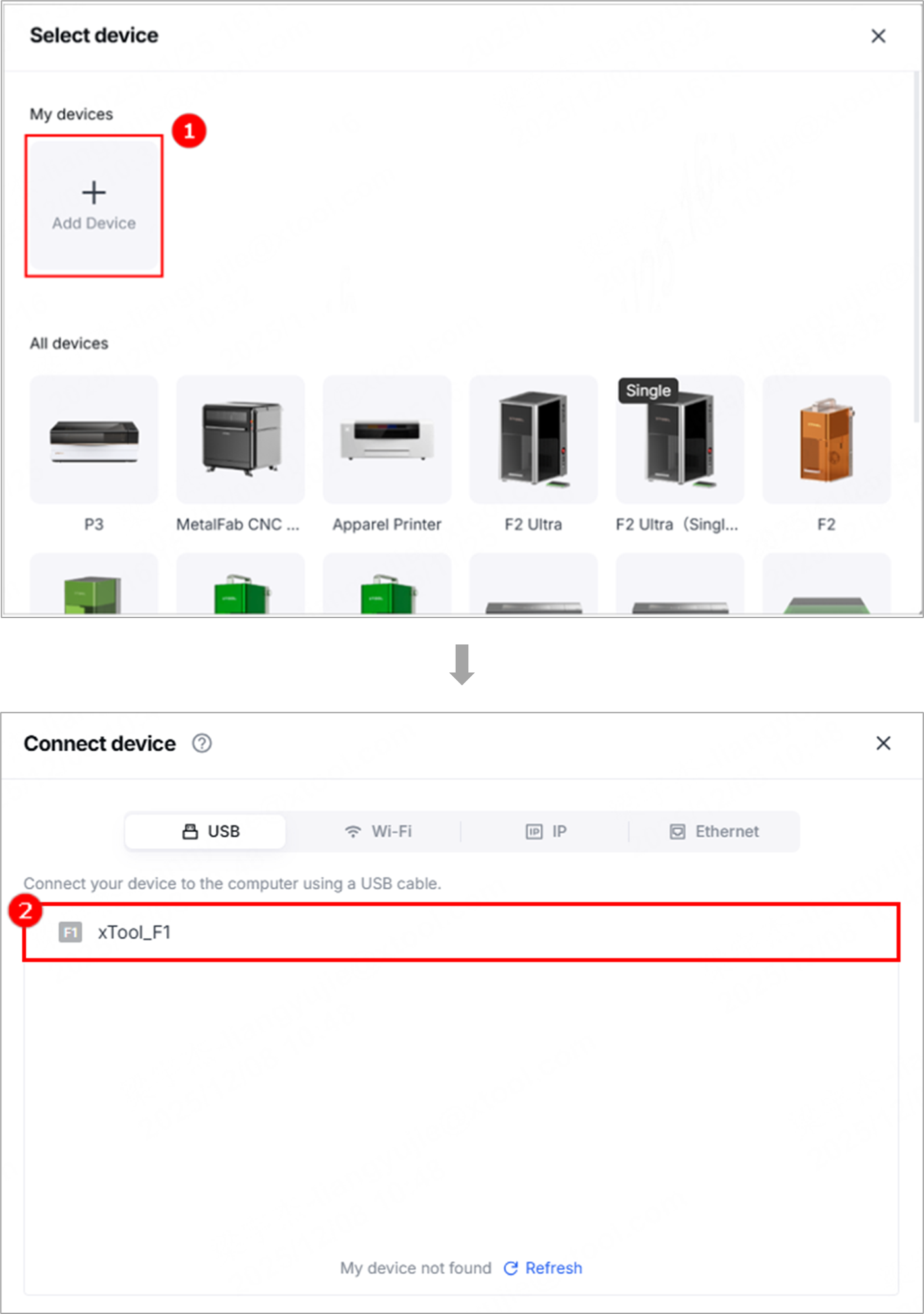
Note: After the device is connected, you can configure Wi-Fi for it so that you can connect it to xTool Studio through Wi-Fi next time.
Wi-Fi connection
(1) In the top-right corner of the software, click > Device settings to enter the device settings page.
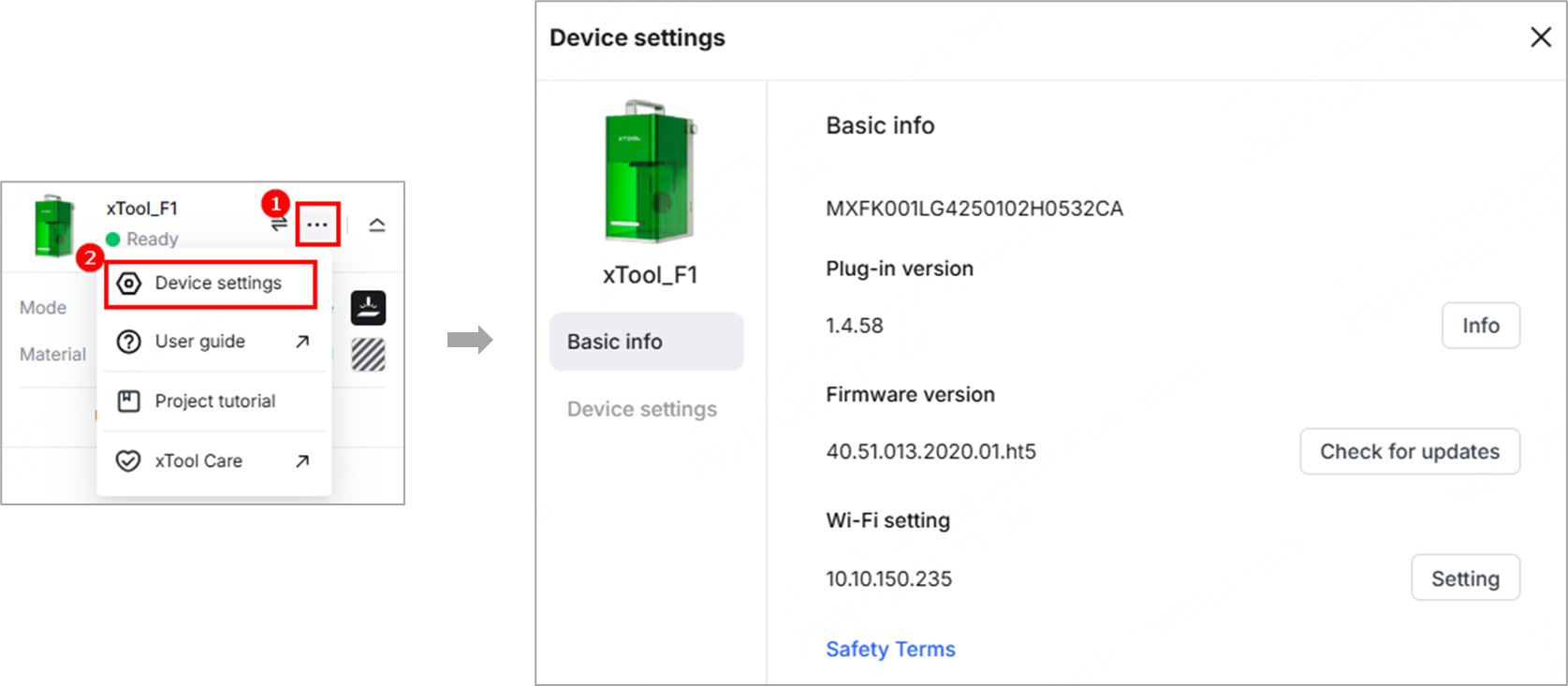
(2) On the Basic info tab page, click Setting for Wi-Fi setting.
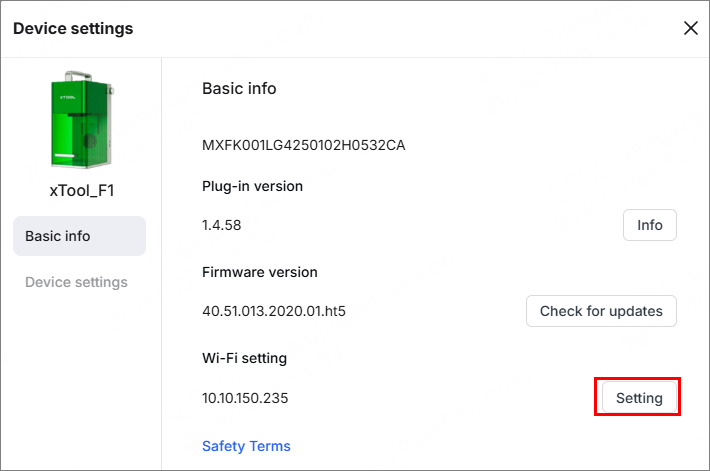
(3) In the Wi-Fi setting dialog box, select a Wi-Fi, enter the password, and click Next.
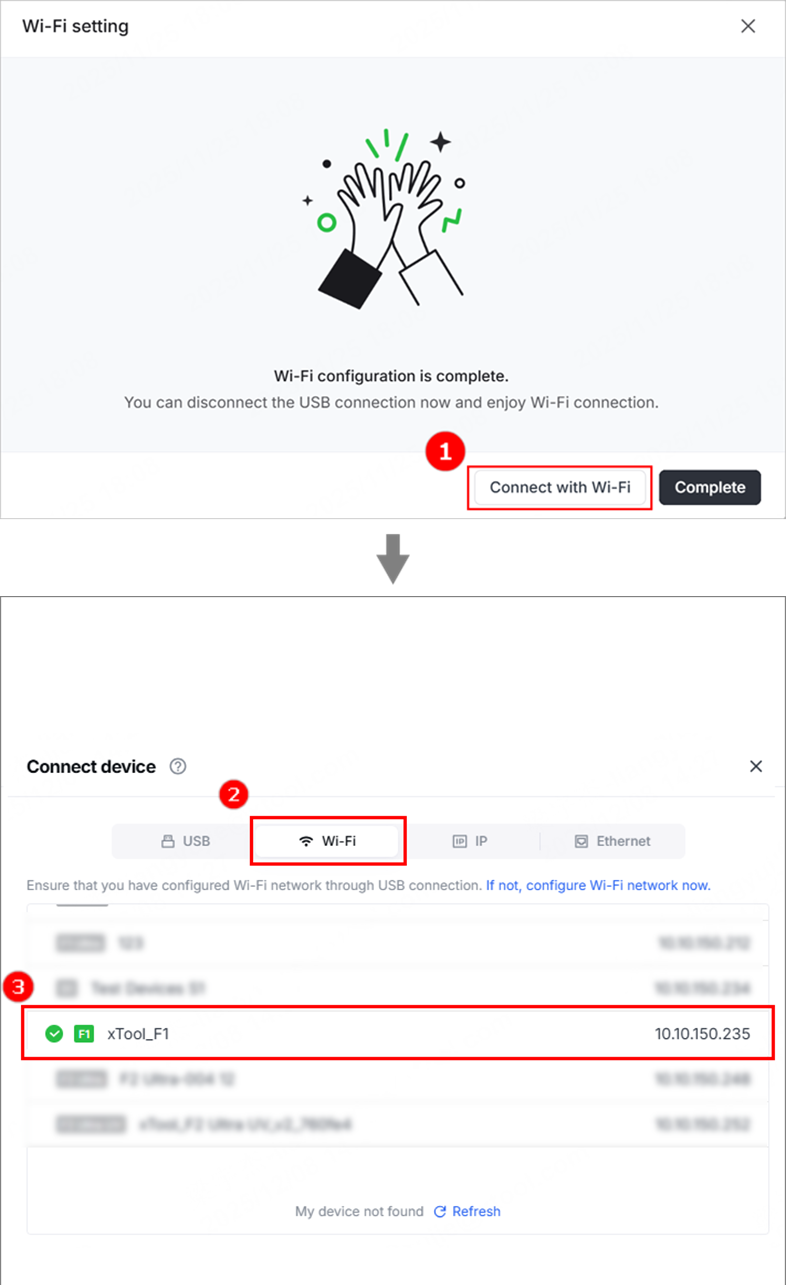
(4) Click Connect with Wi-Fi. In the Connect device dialog box, click Wi-Fi and select the device name to connect to it. If you do not want to connect your device and the computer through Wi-Fi now, click Complete to close the dialog box.
IP address connection
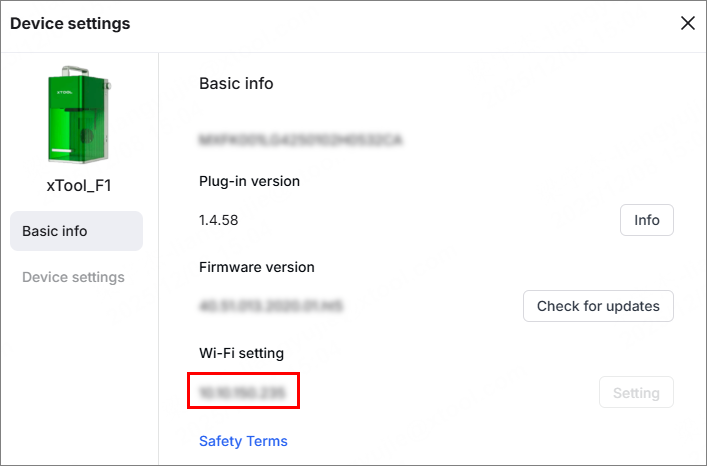
After you complete the Wi-Fi settings for xTool F1/F1 Lite, an IP address is displayed under Wi-Fi setting on the device settings page. You can use the IP address to connect xTool F1/F1 Lite and the computer.
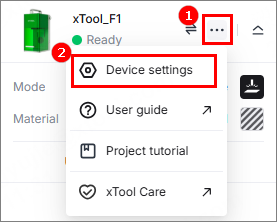
(1) In the top-right corner of the software, click > Device settings to enter the device settings page.
(2) Note down the IP address and return to the canvas page.
(3) On the canvas page, click > Connect Device.
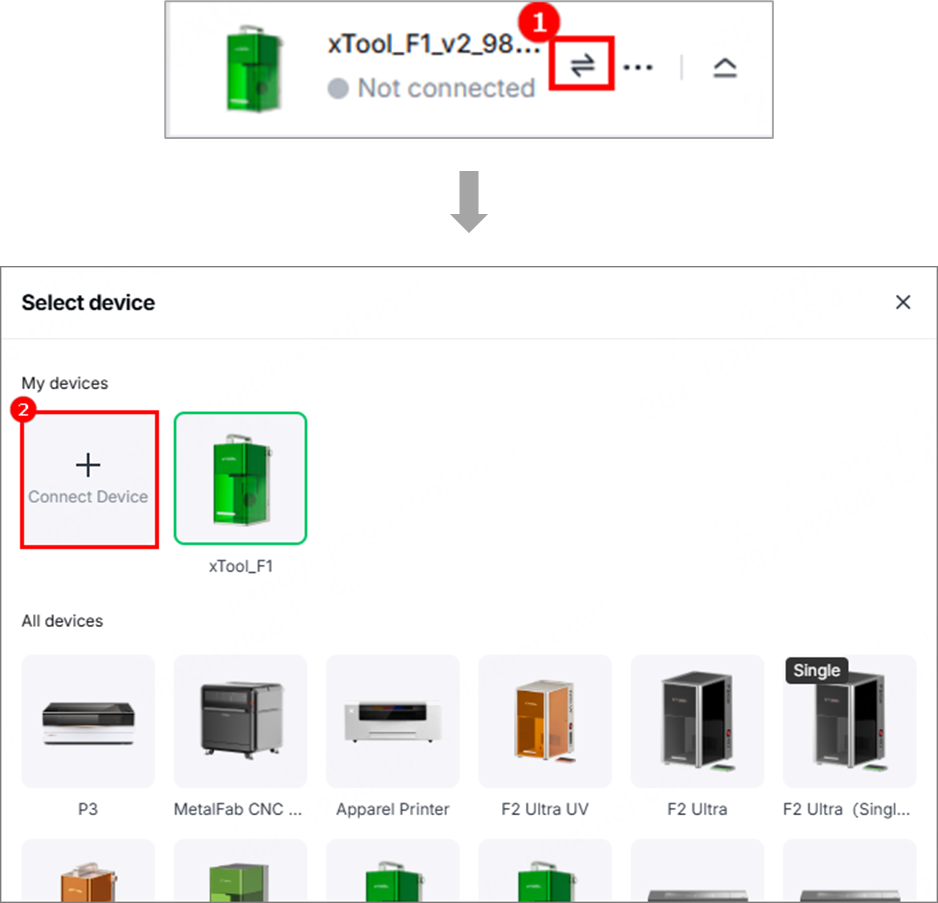
(4) In the Connect device dialog box, click IP, enter the IP address noted down in step (2), and click Connect.
Set up xTool F1/F1 Lite in xTool Studio
(1) In the top-right corner of the software, click the icon > Device settings to enter the device settings page.
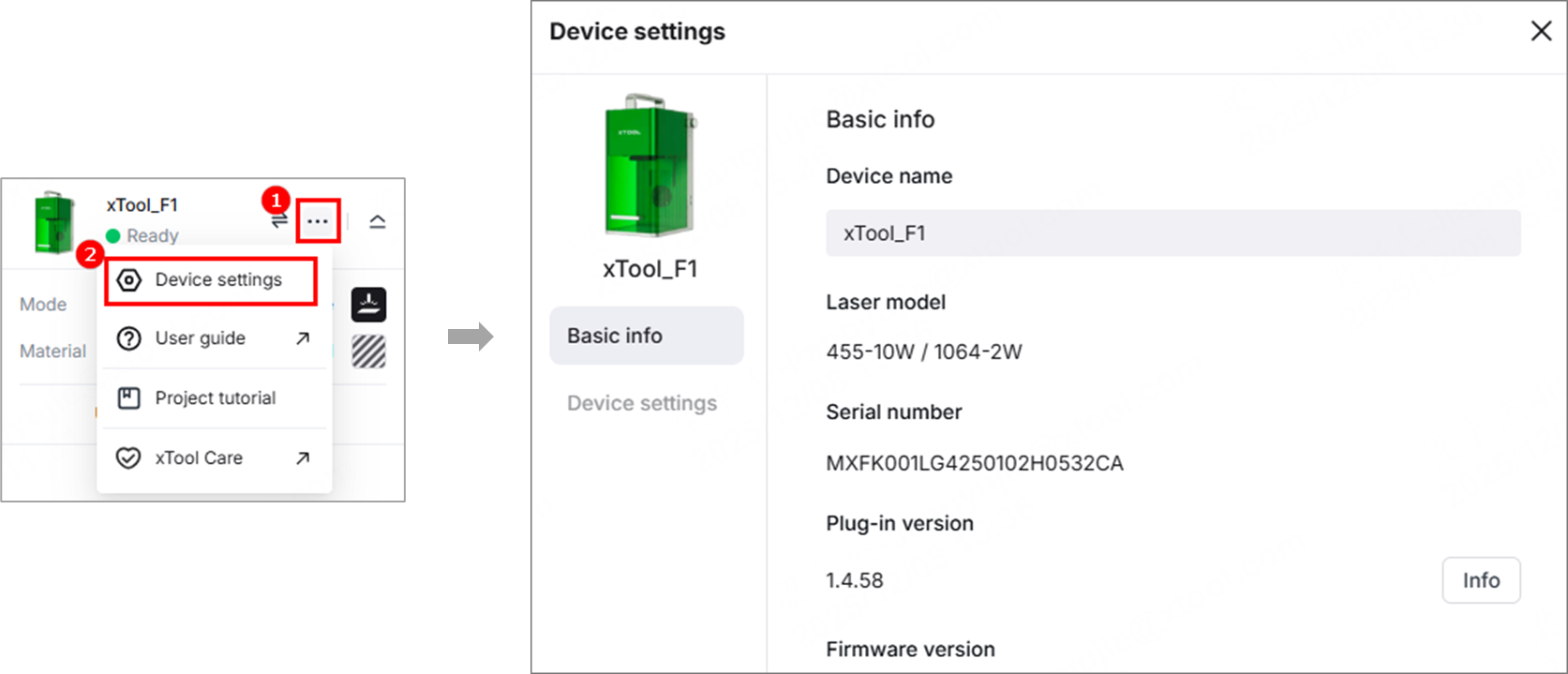
(2) In the Basic info tab page, you can view the basic information of xTool F1/F1 Lite and modify the following information.
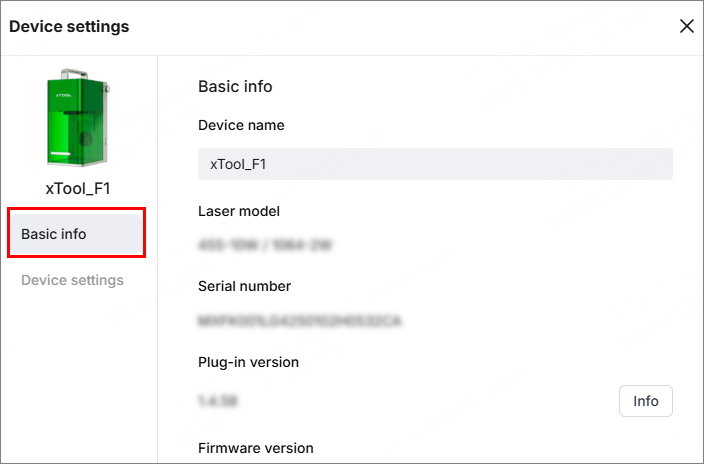
- Device name: Displays the name of the device. You can set a new name for it.
- Laser model: Displays the laser model of the device.
- Serial number: Displays the serial number of the device.
- Plug-in version: Displays the plug-in version of the device. You can click Info to view detailed information.
- Firmware version: Displays the firmware version of the device. You can click Check for updates and update the firmware if a new version is available.
- Wi-Fi setting: Connect the device to a Wi-Fi network.
(3) In the Device settings tab page, you can set up the device and export files as needed.
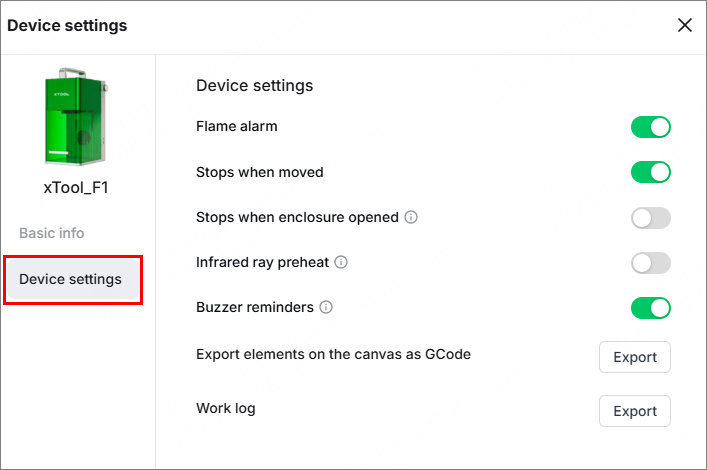
- Flame alarm: If enabled, the device will pause processing and raise the alarm when flame is detected.
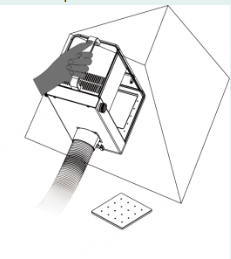
- Stops when moved: If enabled, the device will pause processing when it is moved or tilted during processing. If you plan to perform laser processing on sloped surfaces while hand‑holding the device, disable this feature to ensure normal operation. Refer to the image below.
- Stops when enclosure opened: Processing will be automatically paused when you open the enclosure during processing. To use xTool F1/F1 Lite with its protective enclosure opened, you need to disable this function.
- Infrared ray preheat: In low‑temperature environments, enable the infrared ray preheat function to achieve optimal processing results. If preheat is not enabled, the normal processing sequence may produce unsatisfactory bitmap engraving output due to temperature limitations.
Note: xTool F1 Lite does not support infrared ray preheat - Buzzer reminders: If enabled, the buzzer sounds when the device is ready for processing, and the processing is complete.
- Export elements on the canvas as G-code: You can click Export to export the elements as a G-code file.
- Work log: You can click Export to export the work log.
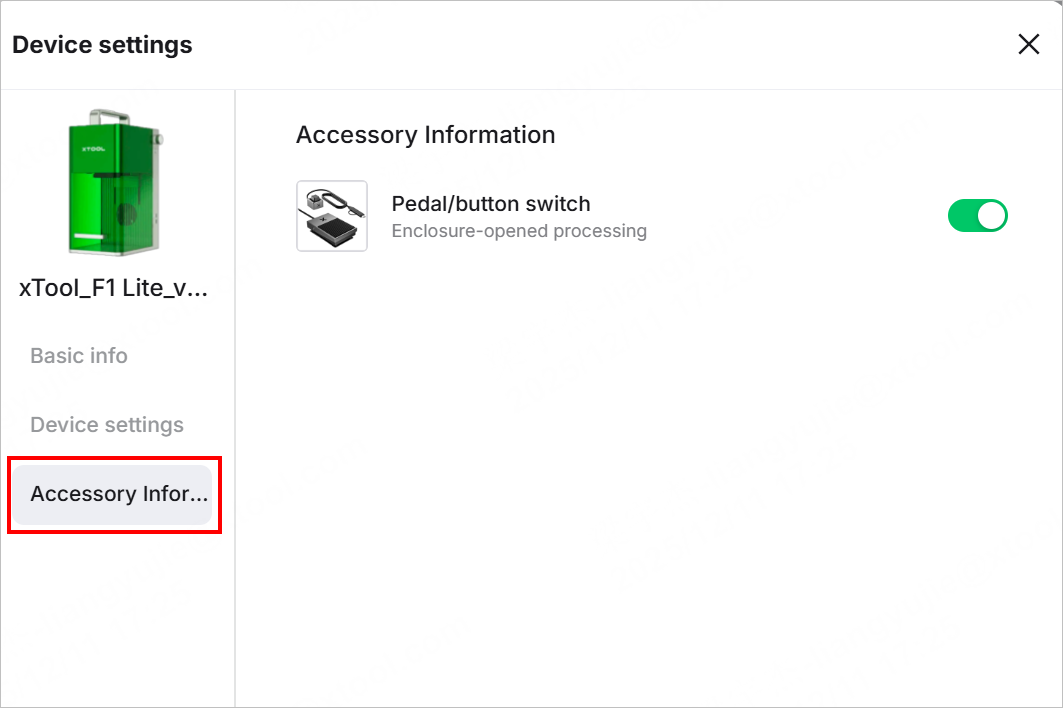
(4) In the Accessory Information tab page, you can see the information about accessories connected to xTool F1/F1 Lite.
Processing modes of xTool F1/F1 Lite
xTool Studio supports multiple processing modes for xTool F1/F1 Lite.
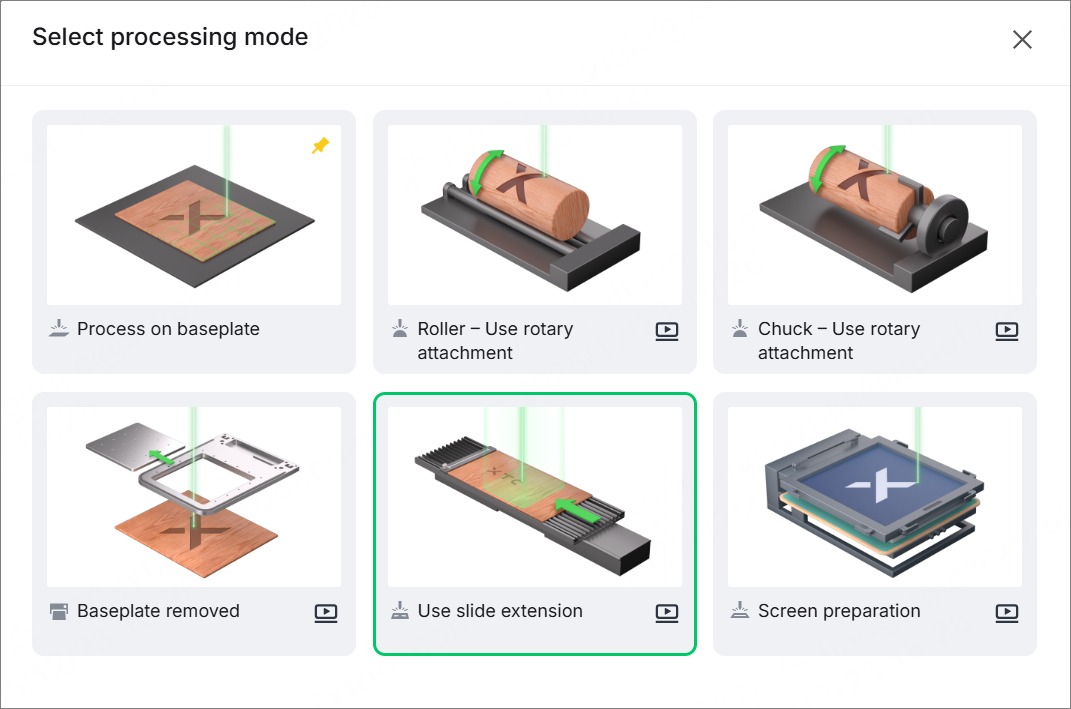
- Process on baseplate: to process small and flat materials
In this mode, you need to place the material on the baseplate of xTool F1/F1 Lite. - Roller – Use rotary attachment: to process irregular cylindrical and extra-long materials
In this mode, you need to use xTool F1/F1 Lite with xTool Rotary Attachment in Roller mode. - Chuck – Use rotary attachment: to process cylindrical materials with rounded or non-rounded bases
In this mode, you need to use xTool F1/F1 Lite with xTool Rotary Attachment in Chuck mode. - Baseplate removed: to process large, sloping, or thick materials
In this mode, you need to take out the removable baseplate from xTool F1/F1 Lite and place xTool F1/F1 Lite on top of the material to be processed. - Use slide extension: to process long materials or multiple small materials at a time
In this mode, you need to use xTool F1/F1 Lite with the slide extension.