1. FAQ
1.1 What is DTF Night-Glow Film?
DTF Night-Glow Film is a direct-to-film transfer material that contains phosphorescent pigments.
After exposure to light, the printed design emits a soft glow in dark environments, creating special visual effects for apparel and accessories.
1.2 Why does the glow gradually fade over time?
The glow effect is produced by phosphorescent particles storing and releasing light energy.
As the stored energy decreases, the brightness naturally reduces until it is no longer visible to the human eye.
This is a normal physical behavior for all glow-in-the-dark materials.
1.3 How long can the glow last?
Under typical indoor lighting:
- The glow is strongest within the first few minutes
- A subtle glow may remain visible for 10–20 minutes depending on distance and ambient darkness
Under strong charging (e.g., sunlight or UV light):
Users may observe a longer-lasting glow
Glow visibility time varies by environment, fabric color, and user’s eye sensitivity
Note: The glow duration of DTF film is naturally shorter than thick HTV (Heat Transfer Vinyl) glow films because the glow layer in DTF film is much thinner (≈ 8–15 μm).
1.4 Why do hot-peel glow HTV (Heat Transfer Vinyl) films glow longer than DTF glow films?
HTV (Heat Transfer Vinyl) glow films use a thicker resin layer (≈ 0.1 mm) containing a higher concentration of glow pigment.
DTF glow films use a thinner ink-absorption layer (≈ 0.01 mm), so pigment loading is limited.
This structural difference results in different glow durations.
1.5 Does the short glow time mean the film is low quality?
No.
DTF Night-Glow Film is designed for:
- Highlight effects
- Short-duration glow visibility
- Kids apparel, party wear, costumes, festival designs, and detail accents
1.6 How can I maximize the glow effect?
- To achieve the best glow result:
- Use stronger charging light:
- Sunlight (best)
- UV/blacklight (excellent)
- Strong LED/fluorescent lamp
- Charge for 2–5 minutes under strong light for optimal effect
- Apply on light-colored fabrics for better visibility
- Ensure the printed area is not covered by thick fabric layers
1.7 Heat Press Parameters
Heat press twice for better
- 1st:
- Temperature: 302-340°F (150-170°C )
- Time: 10–15 seconds
- Pressure: Medium
- 2nd: after peeling, press again,
cover with PTFE Teflon Sheet
- - Temperature: 302-340°F (150-170°C )
- Time: 10–15 seconds
- Pressure: Medium
1.8 Peeling Method
Peel: Cold Peel
Allow the film to cool completely before peeling
This prevents the edges of the glow-in-the-dark pattern from tearing.
The glow-in-the-dark and white ink layers are thicker, making cold peeling more stable.
1.9 Washing Instructions
- First wash: After 24 hours
- Water temperature: Below 40°C (104°F)
- Cycle: Choose gentle or delicate cycle to reduce abrasion
- Turn garment inside out before washing
- Rub gently—avoid scrubbing the print directly
- Do not bleach
- Do not dry clean
- Tumble dry low, remove promptly after drying to avoid creasing.
- Hang to air dry naturally, avoid prolonged direct sunlight exposure during drying to help preserve color and glow pigments.
- Ironing Instructions: Use low heat, iron inside out only, do not iron directly on the print. If necessary, cover the print with a Teflon sheet or parchment paper.
- Special Notes for GITD Films
- Avoid long-term exposure to strong UV light when drying or storing, as this may reduce glow longevity over time.
- The glow effect remains stable, but repeated high-heat drying cycles may reduce brightness transition.
1.10 Why does the camera sometimes “stop capturing” the glow while the eyes can still see it?
Cameras (especially mobile phones) have limited low-light sensitivity.
When brightness drops below the sensor’s threshold, the glow is no longer captured, even though it remains faintly visible to the human eye.
1.11 What environments affect glow visibility?
Glow brightness can be influenced by:
- Strength of the charging light
- Duration of charging
- Ambient darkness
- Distance between viewer and print
- Fabric color (lighter colors enhance visibility)
- User’s eye sensitivity in low light
1.12 Can the glow effect be enhanced through printing techniques?
Yes:
- Increase white ink density under glow areas
- Use larger glow regions for stronger visual impact
- Avoid extremely thin or tiny details in glow zones
- Ensure proper curing for maximum pigment activation
1.13 What are ideal use cases for DTF Night-Glow Film?
Children’s apparel
Halloween, parties, festivals
Night event outfits
Glow accents and highlight elements
Custom gifts, DIY crafts
Small area decorative effects on clothing and bags
DTF Night-Glow Film is not meant for long-duration emergency signage—that category uses thick ceramic-based photoluminescent plates, not thin-film printing materials.
1.14 Does washing affect the glow effect?
Normal washing does not reduce glow capability, as glow pigments are embedded in the cured ink layer.
For best durability:
- Wash inside out
- Avoid high-temperature drying
- Do not bleach
2. Material Structure
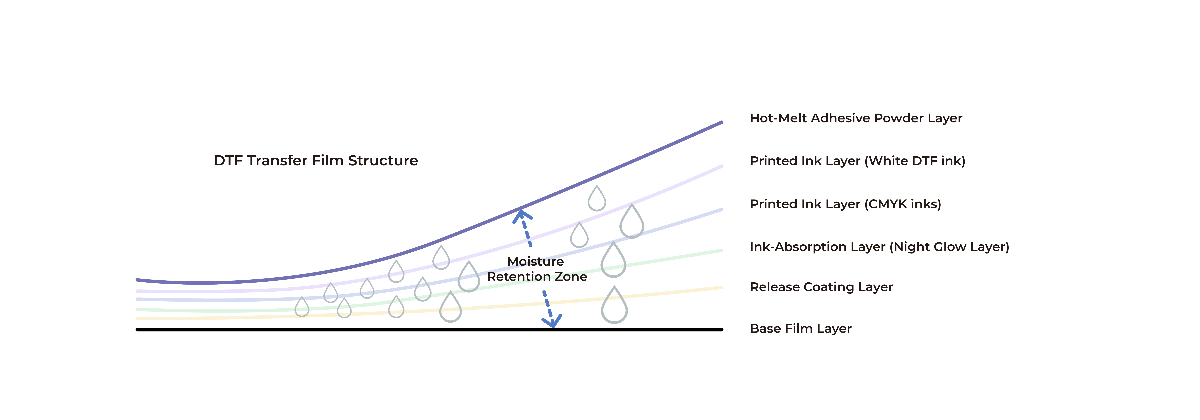
2.1 Base Film Layer
Material: PET
Thickness: 75 μm
Function:
- Provides dimensional stability
- Ensures smooth transportation through printers
- Maintains flatness during printing and curing
2.2 Release Coating Layer
Material: Silicone-based
Function:
- Allows clean peeling after heat pressing
- Prevents ink/adhesive from sticking to the carrier film
2.3 Ink-Absorption Layer (Night Glow Layer)
Material: Water-based polymer resin + phosphorescent pigment
hickness: approx. 8–15 μm
Function:
- Absorbs and locks water-based DTF inks
- Contains a controlled amount of glow-in-the-dark powder
- Charges under light and emits glow in dark environments
Notes:Because the ink-absorption layer is thin, the concentration of glow powder is limited. Therefore, the glow duration is shorter compared to hot peel glow HTV films that contain a much thicker resin layer.
2.4 Printed Ink Layer
Ink: CMYK + White DTF inks
Function:
- Forms the final graphic
- White ink provides opacity and glow enhancement
2.5 Hot-Melt Adhesive Powder Layer
Material: TPU hot-melt adhesive
Particle Size: 80–120 μm
Function:
- Melts and bonds the design to the fabric during heat pressing
- Ensures wash-resistance and elasticity